
Scottsdale Regenerative Insider
Density RF vs. Thermage FLX: What's the Difference?
If you’ve been researching non-invasive skin tightening in Scottsdale, you’ve likely encountered both Thermage FLX and Density Radiofrequency Skin Tighting. Both are monopolar radiofrequency devices. Both stimulate collagen. Both are marketed as non-surgical alternatives to a facelift.
So what separates them, and does the difference matter clinically?
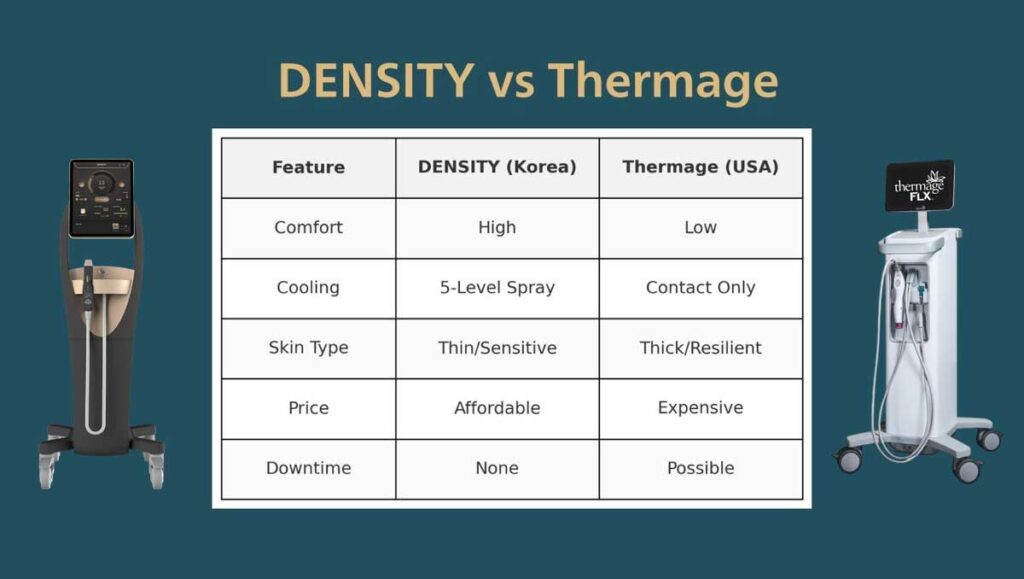
The short answer: yes. The technology has moved forward, and how RF energy is delivered turns out to matter quite a bit for comfort, consistency, and what your skin can actually accomplish in a single session.
Here’s what you need to know.
The Shared Foundation: How Radiofrequency Tightens Skin
Before the comparison, the mechanism deserves a clear explanation, because both devices are built on the same biological principle.
Radiofrequency energy is electrical current oscillating at a precise frequency, in both Thermage and Density RF’s case, 6.78 MHz. When delivered to tissue, this creates resistive (Joule) heating and dielectric heating in the dermis and subcutaneous layers. The heat accomplishes two things: it causes immediate contraction of existing collagen fibers, producing some visible tightening right away, and it triggers the wound-healing cascade, the biological sequence your skin uses to repair itself. That cascade stimulates fibroblasts to generate new collagen and elastin, producing progressive structural improvement over the following weeks and months.
Neither device breaks the skin’s surface. Both are chromophore-independent, meaning RF energy is absorbed by tissue resistance rather than by melanin or hemoglobin. This makes both devices safe and effective across all skin types and Fitzpatrick classifications.
Thermage FLX: The Established Standard
Thermage has been in clinical use since 2002 and FDA-cleared since that first generation. The FLX is the current iteration, introduced in 2018, and it remains the most recognized monopolar RF platform globally.
Thermage FLX delivers monopolar RF energy through a single delivery mode, monopolar only, using a capacitive coupling mechanism at 6.78 MHz. The current generation features AccuREP™ technology, which measures skin resistance in real time and adjusts energy output accordingly, and a vibrating handpiece designed to improve comfort during treatment. The Total Tip 4.0 cm² tip expanded the treatment surface area relative to the prior generation, reducing treatment time by approximately 25% to 33%.
Thermage’s primary targeting depth is the dermis, subcutaneous fat, and fascia. The monopolar configuration means current flows from the treatment tip through the tissue to a grounding pad, allowing energy to penetrate to depth, 4.3 mm or more depending on tip and settings. It creates broad volumetric heating, which is effective for deep remodeling and soft tissue contraction.
What Thermage does well:
- Deep volumetric collagen remodeling
- Global clinical track record spanning two decades
- Results achievable in a single session, though that single session comes with a meaningful comfort demand and significant per-treatment cost
The honest limitation:
Thermage delivers monopolar energy only. That means it targets depth effectively but has no mechanism for simultaneously addressing the upper dermis or skin surface quality. Texture refinement, immediate surface tightening, and superficial collagen remodeling are not within its design scope. Because the energy is monopolar throughout, comfort management relies primarily on the vibration mechanism and provider technique. Some patients find the treatment uncomfortable. The single-treatment model, while convenient in concept, may produce results that are less predictable for patients with significant skin laxity.
Density RF by Jeisys: Dual-Mode Sequential Energy Delivery
Density RF is a next-generation RF platform developed by Jeisys, a South Korean medical device company with over 25 years of aesthetic technology development and more than 15,000 systems installed globally. Jeisys is also the manufacturer of the Potenza RF microneedling system.
Where Density distinguishes itself from Thermage and all prior monopolar-only devices is in its sequential dual-mode energy delivery: monopolar RF followed immediately by bipolar RF in a single pulse sequence.
The pulse pattern works as follows: five monopolar pulses are delivered, with cryogen cooling between pulses, followed by a bipolar pulse as the final step in the sequence. This is not simply two modes of energy toggling independently, it is a structured, sequenced treatment of the full dermal architecture within each pass.
What each mode contributes:
- Monopolar RF (6.78 MHz): Penetrates to the dermis, subcutaneous fat layer, and fascia. Triggers long-term collagen remodeling via the wound-healing cascade. This is the deep structural work—the same principle Thermage has used since 2002.
- Bipolar RF (6.78 MHz): Targets the upper dermis and superficial skin layers. Because bipolar current travels between two electrodes on the same handpiece, its depth is more limited and more controlled. The bipolar component produces immediate superficial tightening, texture refinement, and earlier visible results—typically within one to four weeks—while the monopolar remodeling continues for months.
- The real-time calibration system (RAC): Like Thermage’s AccuREP, Density measures skin impedance in real time and automatically adjusts energy delivery to compensate for variation in skin resistance. This matters clinically: skin resistance varies across anatomical zones, individual patients, and hydration states. Auto-calibration ensures consistent energy delivery without requiring the provider to manually adjust settings across the face or body.
- The cooling system (SAC): Density uses cryogen-based Smart Adjustable Cooling with five programmable levels. The cooling is integrated into the pulse sequence, not simply applied between pulses, and is designed to protect the epidermis while allowing effective energy delivery to depth. This is a meaningful comfort and safety improvement over devices that rely primarily on vibration or topical cooling.
- Collagen output: Clinical data from Jeisys positions Density’s sequential monopolar-plus-bipolar delivery as producing up to five times more collagen stimulation than traditional single-mode monopolar RF alone. That figure comes from the cumulative effect of treating both deep and superficial tissue layers in the same pass rather than targeting depth alone.
- Treatment design flexibility: Density offers both a Stamping Technique for precise zone-specific tightening (nasolabial folds, perioral area) and a Moving Technique for broader lifting and contouring (cheekbones, jawline). This design flexibility, combined with facial anatomy scanning, allows the provider to create an individualized treatment map rather than applying uniform energy across the entire face.
Side-by-Side: Density RF vs. Thermage FLX
| Density RF (Jeisys) | Thermage FLX (Solta) | |
|---|---|---|
| Energy modes | Sequential monopolar + bipolar | Monopolar only |
| Frequency | 6.78 MHz | 6.78 MHz |
| Target depth | Dermis through fascia (monopolar) + upper dermis (bipolar) | Dermis through fascia |
| Real-time calibration | Yes (RAC) | Yes (AccuREP™) |
| Integrated cooling | Cryogen, 5 programmable levels | Vibration + surface cooling |
| Surface/texture treatment | Yes (bipolar component) | No |
| Skin type suitability | All Fitzpatrick types | All Fitzpatrick types |
| Typical sessions | 1–2, spaced 4–6 months | Usually 1 |
| Downtime | None | None |
| Results timeline | Immediate surface + progressive over 3+ months | Progressive over 3–6 months |
Who Is the Right Candidate for Each?
Density RF tends to be the stronger choice when:
- The collagen tightening and skin quality improvement (texture, tone, superficial laxity) is wanted in the same session
- Comfort is a significant concern, the integrated cryogen cooling and auto-calibration make the treatment experience more manageable
- Those in their 40s, 50s, or 60s who to address early-to-moderate laxity with progressive collagen building rather than a single aggressive intervention
- A history of finding monopolar RF treatments uncomfortable
- A preference for the regenerative approach to aging skin is the priority: building collagen density over time rather than a one-and-done model
Thermage FLX tends to be preferred when:
- Two decades of global clinical data and a well-documented outcome record is most important
- A single-session treatment model is non-negotiable due to schedule or travel constraints
- Deep tissue contraction and volumetric heating are the primary objectives
What This Means in a Regenerative Aesthetics Context
At Rejuvience Med Spa in Scottsdale, we approach skin tightening the same way we approach every treatment: through the lens of what the biology actually supports.
Radiofrequency, when delivered correctly, works with the skin’s own repair mechanisms rather than against them. The wound-healing response the radiofrequency skin tighting triggers is the same cascade that produces collagen following any controlled tissue stimulus. What matters is whether that stimulus is delivered consistently, at the right depth, and in a way the tissue can respond to optimally.
Density RF’s dual-mode architecture addresses something that single-mode monopolar devices cannot: the full dermal architecture in one pass. The upper dermis and lower dermis have different structural roles and different timelines for response. Treating both in sequence, with real-time calibration ensuring energy consistency across each zone, is a more complete approach to collagen remodeling than depth-only targeting.
For those dealing with aging skin in their 50s and 60s, where collagen density, surface quality, and structural support are all declining simultaneously, a treatment that addresses multiple layers in a single session has genuine clinical advantages.
That said, device selection always starts with your specific anatomy, degree of laxity, skin quality, and goals. A thorough consultation, not a device preference, should drive the treatment plan.
The Bottom Line
Thermage FLX is a proven, well-documented skin tightening platform with a unique eyelid clearance and a two-decade clinical record. If a single-session monopolar RF treatment is what you need, it remains a credible option.
Density RF by Jeisys represents the next evolution of RF technology: sequential monopolar and bipolar energy delivery, integrated cryogen cooling, real-time auto-calibration, and a treatment design that addresses the full dermal architecture rather than depth alone. For patients who want both structural tightening and surface quality improvement, without needles, without downtime, and with a more comfortable treatment experience, Density RF is the more complete platform.
Rejuvience Med Spa provides Density RF skin tightening as part of our regenerative aesthetics practice in Scottsdale. If you’re considering RF skin tightening and want to understand which approach makes sense for your skin, we invite you to schedule a complimentary consultation.
Scottsdale Regenerative Insider is the official blog of Rejuvience Med Spa. We believe in transparent, evidence-based aesthetics that utilize your body’s natural ability to heal and renew.
Get the Regenerative Edge! Receive our latest regenerative research and exclusive med spa offers directly to your inbox.
We respect your privacy. We never sell or share your personal information.