
Scottsdale Regenerative Insider
DENSITY vs XERF: What's the Difference?
DENSITY and XERF are both needle-free radiofrequency skin-tightening systems designed to heat collagen-rich tissue without surgical incisions or social downtime. The important difference is how they deliver that RF energy.
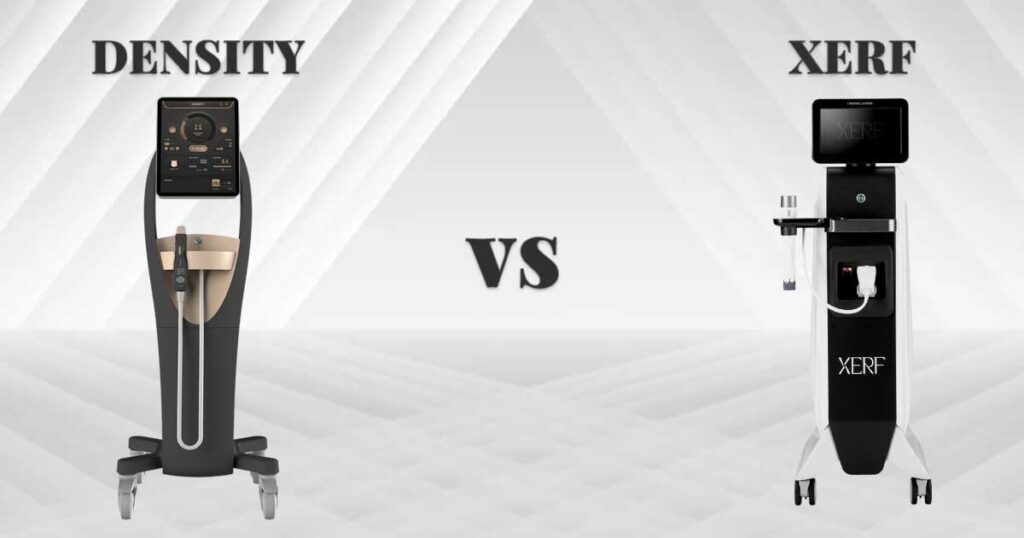
The DENSITY at Rejuvience Med Spa Scottsdale combines two RF configurations, monopolar and bipolar, in sequence. XERF stays monopolar but uses two RF frequencies, 6.78 MHz and 2 MHz, with adjustable depth settings.
That distinction sounds technical, but it is the main reason these two Korean RF platforms are not simply different brand names for the same treatment.
DENSITY vs XERF at a Glance
| Feature | DENSITY RF | XERF |
|---|---|---|
| RF design | Sequential monopolar + bipolar | Multifrequency monopolar |
| RF frequency | 6.78 MHz | 6.78 MHz + 2 MHz |
| How depth is varied | Changes RF configuration within the pulse | Uses frequency and adjustable depth settings |
| Needles | No | No |
| Numbing | Not normally required | Designed as a no-numbing treatment |
| Epidermal cooling | Cryogen cooling | Cryogen cooling |
| Impedance feedback | Yes | Yes |
| Downtime | Little to none | Little to none |
| Primary treatment logic | Deep + more superficial RF remodeling in sequence | Monopolar RF delivered at selectable depths |
Both DENSITY and XERF belong in the same broad category: non-invasive RF skin tightening. The engineering is different.
The Difference Is Polarity vs Frequency
This is the cleanest way to understand DENSITY and XERF.
DENSITY changes polarity. Its new High Tip delivers monopolar RF followed by bipolar RF within the same treatment pulse. Monopolar RF sends current between the treatment electrode and a return pad, allowing broader, deeper heating. Bipolar RF passes energy between electrodes positioned close together, concentrating heating more superficially.
The point of combining them is to treat more than one level of the dermis during the same treatment rather than relying only on monopolar heating.
XERF changes frequency. It remains a monopolar RF system but combines 6.78 MHz and 2 MHz frequencies. The platform also provides three depth settings and ten intensity levels, allowing the provider to change how energy is distributed according to the treatment area.
So although both devices are sometimes described as using “dual” RF technology, they are dual in different ways.
- DENSITY: two RF configurations.
- XERF: two RF frequencies.
That is the meaningful technical distinction.
What Do DENSITY and XERF Have in Common?
Both use radiofrequency energy to create controlled heating below the skin surface. That thermal stimulus is intended to contract existing collagen and trigger a longer remodeling response as new collagen develops.
Neither requires needles. Both use cryogen-based cooling to protect the skin surface and improve comfort, and both use impedance feedback to help control energy delivery as tissue resistance changes.
That makes both attractive to people who want to address mild to moderate laxity without RF microneedling, surgery, or several days of visible recovery.
Neither should be confused with a facelift. RF can improve skin firmness and definition; it cannot remove substantial excess skin or reposition deeper facial tissues surgically.
What Makes DENSITY Different?
DENSITY’s defining feature is sequential monopolar-bipolar RF.
Jeisys designed the new High Tip to deliver deeper monopolar heating followed by more localized bipolar heating in one sequence. The platform operates at 6.78 MHz and uses real-time impedance monitoring plus adjustable cryogen cooling.
For aging skin, this design is important because skin laxity and skin quality are not always happening at exactly the same depth. A softer jawline may need deeper collagen remodeling while thinner, more finely wrinkled skin also has changes closer to the surface.
At Rejuvience Med Spa in Scottsdale, that is one reason we use DENSITY for areas that show aging, such as the lower face, jowls, neck and deepening perioral area lip lines and smile lines. It gives us a non-invasive, zero downtime way to address structural firmness while also treating more superficial dermal tissue in the same session.
What Makes XERF Different?
XERF takes a different engineering approach.
Cynosure Lutronic designed XERF as a multifrequency monopolar RF system using both 6.78 MHz and 2 MHz energy. Rather than adding bipolar RF, it changes frequency and treatment depth within its monopolar platform.
XERF does provide three depth settings, ten intensity levels, impedance feedback and integrated cryogen cooling designed to deliver substantial RF energy without requiring numbing.
That makes XERF a legitimate competitor in exactly the same consumer category as DENSITY: people who want RF skin tightening without needles or downtime.
Is DENSITY Better Than XERF?
The device specifications alone do not support a universal winner.
DENSITY’s monopolar-bipolar architecture and XERF’s multifrequency monopolar architecture are genuinely different, but a technical difference is not the same thing as proof that one device will produce a better result on every face.
Treatment outcome also depends on the degree and location of laxity, skin thickness, treatment area, energy settings, number of passes, provider technique and whether RF is actually the right treatment category for the problem.
This is where comparison articles often go wrong. They turn engineering differences into blanket superiority claims.
A better question is: which RF approach makes sense for the tissue you are trying to change?
The Bottom Line
DENSITY and XERF solve a similar problem with different RF architecture.
DENSITY combines monopolar and bipolar RF sequentially. XERF combines two frequencies within a monopolar RF system. Both are needle-free, use active cooling, and are designed for progressive collagen-based tightening with virtually zero downtime.
If you’re comparing RF skin tightening in Scottsdale, the device name matters less than whether the treatment matches the degree of laxity, skin quality, and treatment area.
Rejuvience Med Spa Scottsdale uses the DENSITY RF specifically for age 50+ skin to treat age-related and weight loss-related collagen loss that makes the lower face sag, jowls to emerge, smile lines to deepen, vertical lip lines to become pronounced, and the neck to wrinkle.
Is a DENSITY RF skin tightening treatment right for you? Find out by booking a complimentary consultation. There’s no cost, and there’s never an obligation. Just a conversation about what you want to achieve and what DENSITY RF can and can’t do.
Scottsdale Regenerative Insider is the official blog of Rejuvience Med Spa. We believe in transparent, evidence-based aesthetics that utilize your body’s natural ability to heal and renew.
Get the Regenerative Edge! Receive our latest regenerative research and exclusive med spa offers directly to your inbox.
We respect your privacy. We never sell or share your personal information.