
Scottsdale Regenerative Insider
Exosomes: One Word. Very Different Products.
Exosomes are everywhere; in exosome therapy, microneedling, and microchanneling treatment descriptions, in professional skincare lines, and in over-the-counter products. The word “exosomes” doesn’t tell you much. Product sourcing, purity, and clinical proof vary widely.
About Exosomes
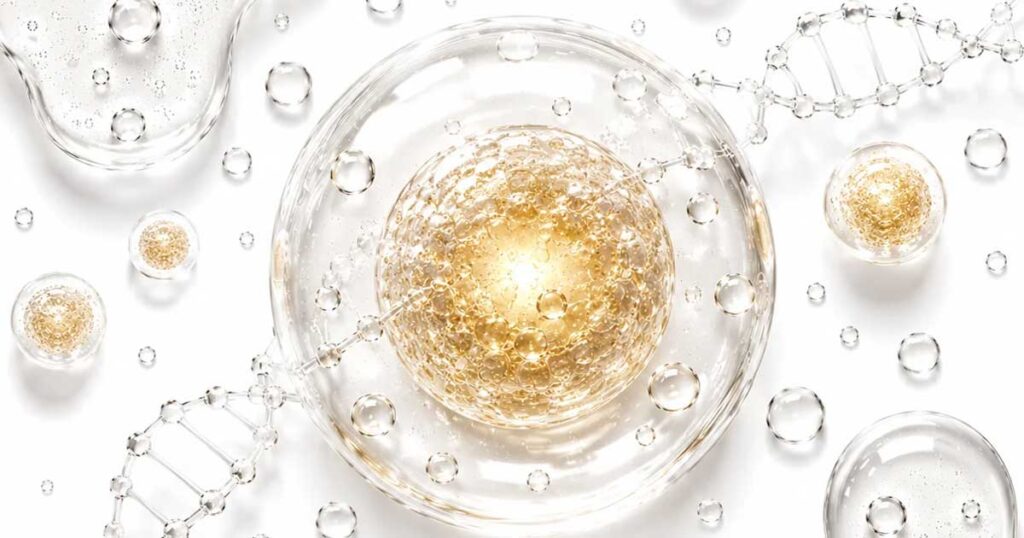
Exosomes are tiny lipid sacs that deliver a payload of messaging molecules (growth factors, proteins, lipids) that tells cells to repair themselves, reduce inflammation, and accelerate tissue regeneration. When they were first isolated, scientists had a massive hurdle: exosomes degrade almost instantly at room temperature.
The professional exosomes used in exosome therapy at a med spa and an exosome serum for at-home use aren’t the same. Today’s professional exosomes for in-clinic application are the product of industrial processes that drop temperatures down to -40°C, use a deep vacuum to vaporize the ice, and seal the vials under a sterile nitrogen gas blanket.
They are typically stored freeze dried in the refrigerator or freezer and mixed with a liquid solution (with varying ingredients) just before treatment. Once mixed, the fragile exosomes begin to break down and lose their potency quickly at room temperature. They’re usually only good for the next 1 to 3 hours.
Professional and over-the-counter skincare line creams and serums for home use can contain human-derived exosomes, plant derived exosomes, biomimetic (lab engineered) exosomes, including AnteAGE proprietary Biosomes in professional solutions, the AnteAGE MD System, and new AnteAGE INTENSIFY serums.
High-quality exosome products are expensive, but not every expensive product is high quality. This is what you need to know.
Human-Derived, Lab Engineered, and Plant-Derived: Three Different Approaches
One of the most important things to understand when buying an in-clinic or home care products is where the molecules come from. There are three possible sources, human-derived, lab engineered, and plants.
Human-Derived Exosomes
Human-derived exosomes are collected from cultured cells or platelets that have several human sources. They carry biological material associated with those sources, not living stem cells. These products include:
- AnteAGE MDX Exosome Solution and AnteAGE P.E.A.R.L. contain human-derived exosomes cultured from healthy female bone marrow donors along with human umbilical cord stem cells (Wharton’s Jelly) that signal cells to produce more collagen and elastin while communicating between themselves better.
- BENEV Exosome Regenerative Complex exosomes are sourced from adult fat (adipose) tissue legally and voluntarily donated by healthy female donors (typically aged 21 to 23).
- Plated uses human platelet-derived exosomes that target redness, calming inflammation, and rapid skin barrier recovery.
They share the term “human-derived,” but they aren’t the same.
Lab Engineered Biosomes
When AnteAGE introduced its AnteAGE MDX Biosome technology in September 2024, it was the first-ever biomimetic exosome to hit the market. Biomimetic means imitating or copying structures, processes, or systems found in nature to solve human design and engineering problems.
AnteAGE Biosomes are manufactured particles developed to mimic aspects of exosome structure and function without collecting the particles from human cells.
AnteAGE developed Biosomes to gain share in European markets. The European Union has some of the strictest cosmetic safety regulations in the world. These include prohibiting any ingredients derived from human origin, such as human cell-conditioned media and human-extracted exosomes.
Natural Exosomes
- Are notoriously fragile, delicate biological structures. Once reconstituted, they remain stable for a very short window of time and often require precise, fragile refrigeration (cold-chain shipping) to keep the proteins from degrading.
- Contain a complex, organic payload inherited directly from their parent stem cells, which includes an unpredictable variety of growth factors, natural proteins, cytokines, and remnants of cellular genetic material (RNA fragments).
vs Lab Engineered Biosomes
- Are optimized, nano-engineered lipid membranes specifically built to withstand the oils and surfactants in topical creams. This makes them stable at room temperature so they can be packaged into at-home daily serums and creams.
- Are engineered to carry a precise, curated signaling molecule payload and built in a laboratory. They use recombinant human proteins (proteins grown via bacteria to mirror human structure) but contain zero DNA or RNA fragments.
- Lab engineered Biosomes gives people an option for a regenerative topical that aren’t human-derived. They are available in professional solutions (AnteAGE MDX Biosomes is one) and in home care products like the AnteAGE MD Biosome System.
Plant-Derived “Exosomes”
Plants also produce small membrane-enclosed particles somewhat like human exosomes that contain biological material. They are technically called “plant extracellular vesicles” (PEVs), but most often referred to “plant exosomes” in skincare products. They are typically sourced from botanicals like Centella asiatica (Cica), ginseng, or green tea.
The content of PEVs is very different from those of human-derived exosomes. PEV “cargo” is plant polyphenols, phytochemicals, and vitamins. They can’t bind to human cells to signal creating more collagen and elastin, but they function primarily as antioxidant delivery systems. PEVs do help reduce oxidative stress, calm inflammation, and support skin barrier repair.
Where Do Growth Factors Come In?
Growth factors are signaling proteins. Exosomes can carry signaling material, but growth factors are incorporated into a broad range of skincare products. The term describes biology, not a specific ingredient. Again, sourcing matters.
- AnteAGE MD Growth Factor Solution is sourced from human-derived exosomes cultured from healthy female bone marrow donors. It is applied in-clinic after treatments that create channels so it can penetrate into the dermal layer.
- SkinMedica TNS is a home care product that provides growth factors derived from human fibroblast conditioned media with an original cell line from a newborn circumcision donation over 20 years ago.
- Neocutis home care products, such as BIO SERUM FIRM, contain human growth factors from an original cell line from an electively 14-week old aborted fetus.
These products belong in the same broad regenerative-skincare conversation because they aim to improve skin quality through bioactive ingredients. That doesn’t make them the same technology.
What Changes Between the Treatment Room and Home?
Source is one question. Formulation is another. The same general technology for professional in-office use can be found in home daily skincare products. What changes is the complete formula, how it’s prepared, and how it’s meant to be used.
Professional Exosome Products
Professional exosomes are ultra-concentrated with billions of exosomes, are almost always supplied freeze-dried, and must be mixed with a dilutant that be anything from plain hyaluronic acid to mix of peptides, amino acids, and other supportive ingredients. They’re designed to be applied immediately following a controlled injury to the skin, such as skin resurfacing, microneedling, and microchanneling. The temporary microchannels they create in the skin barrier allow the large exosome vesicles to penetrate into the deeper dermal layers where collagen is made.
Homecare Exosome Products
Homecare products are typically formulated to be shelf-stable at room temperature. They have drastically lower concentrations designed to deliver steady, cumulative results over months. Because homecare products can’t use channels created by controlled injuries to penetrate the skin barrier, they use liposomal encapsulation (wrapping the ingredients in an oil bubble that can slip past the skin barrier) or low-molecular-weight carrier systems so the active signaling molecules can be absorbed through intact skin.
The BENEV EXO Balm Hybrid
There is one exosome homecare product that isn’t shelf-stable at room temperature – BENEV EXO Balm. Freeze dried exosomes get mixed into the EXO Balm moisturizing base in-clinic, must be kept in the fridge, and are good for up to 21 days after mixing.
EXO Balm is often dispensed for extending exosome therapy after a professional treatment. It can also be dispensed to help restore a distressed skin barrier caused by environmental sensitivities (including travel), severe skin dehydration, or skin that’s chronically inflamed.
What's Best for Your Skin?
An understanding of the science is one thing. Knowing what’s best for your skin is another. If you’re trying to decide whether an in-clinic exosome treatment, a homecare product, or both makes sense, a complimentary consultation is a good place to start. We’ll take a look at your skin, listen to what you want addressed, and let you know what today’s most advanced regenerative aesthetics technologies can and can’t do. There’s no cost, and there’s never any obligation.
Scottsdale Regenerative Insider is the official blog of Rejuvience Med Spa. We believe in transparent, evidence-based aesthetics that utilize your body’s natural ability to heal and renew.
Get the Regenerative Edge! Receive our latest regenerative research and exclusive med spa offers directly to your inbox.
We respect your privacy. We never sell or share your personal information.