
Scottsdale Regenerative Insider
What Fixes Ozempic Face? Regenerative Repair
“Ozempic face” describes the facial changes that can follow rapid GLP-1 weight loss: flatter cheeks, hollow temples and under-eyes, and increased laxity through the lower face. It can occur in people taking Ozempic, Wegovy, Mounjaro, and similar medications, and the number of people experiencing it continues to grow.
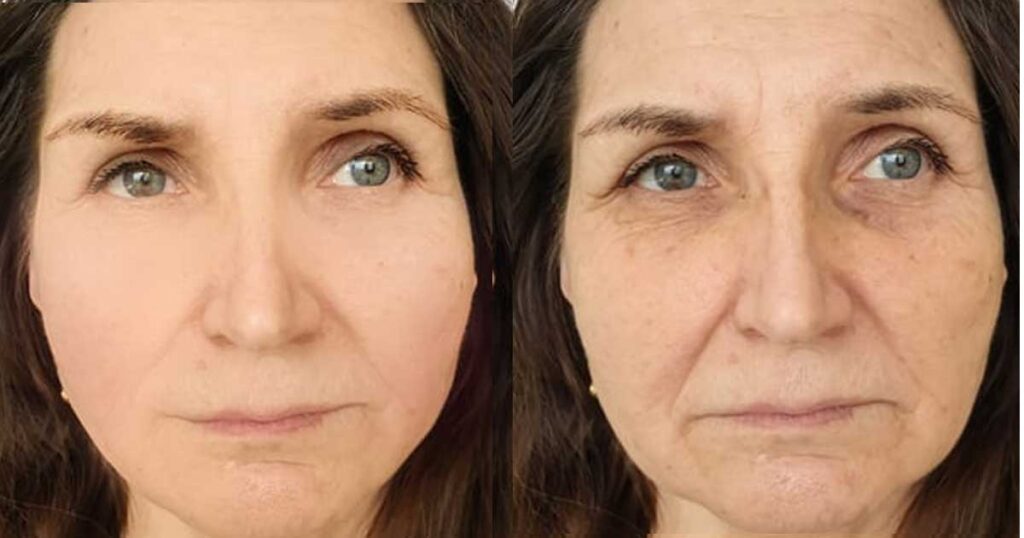
The conventional response is to replace lost volume with filler or Sculptra. That may soften the hollows temporarily, but it addresses only part of the problem. Rapid weight loss also changes the skin itself, affecting firmness, density, and support. Restoring volume without repairing the skin leaves half the problem untreated.
Facial Volume Loss and Skin Quality Loss Are Separate Problems
Rapid weight loss changes two things at once: the volume under the skin and the quality of the skin over it.
When the fat compartments shrink, the midface and temples flatten and the jawline softens, because those pads gave the face its support. At the same time, skin that used to cover a fuller face now has more surface than structure beneath it, so it reads as lax, thin, and crepey.
These are different problems with different fixes. Volume loss is a question of lost support underneath. Skin-quality loss is a question of the tissue’s own strength.
A treatment that only restores volume leaves the skin side untreated. A refilled face after major weight loss can still look loose.
Why GLP-1 Medications Change Facial Fat and Skin
Imaging puts numbers on the fat loss. In a 2025 study in Otolaryngology–Head and Neck Surgery, researchers measured patients’ faces before and after starting a GLP-1 and found median midface volume down about 9 percent, with the superficial fat pads down about 11 percent. The loss tracked with weight: roughly 7 percent of midface volume for every 10 kilograms lost.
The fat leaves the face in the same pattern that reads as aging.
The skin change has a separate cause. Dermatologist Sabrina Fabi has described how GLP-1s lower glucose uptake in adipocyte-derived stem cells, the precursor cells that can turn into fibroblasts. Without that fuel, those cells differentiate more slowly and produce less collagen, elastin, and hyaluronic acid. Fat volume drops. Fibroblast activity slows. Collagen and elastin production falls behind.
Speed matters as well. When weight comes off quickly, the skin gets no time to recoil, so laxity shows most in the chin, jaw, and lower face. This is not the drug damaging skin directly. It is fat loss outpacing the skin’s ability to adapt, while the cells that would firm it back up are running low on the energy to do it.
The deficit is structural: less fat, and fewer working cells to rebuild collagen and elastin.
The Limits of Fillers for GLP-1 Facial Changes
Filler fills a hollow cheek or temple. It does not prompt the skin to make collagen or elastin, so tissue quality stays where the weight loss left it.
Mainstream coverage has started to say the same thing. In a July 2025 CNN report on the rise in cosmetic procedures after GLP-1 weight loss, surgeons noted that “fillers can only do so much,” and that chasing large volume loss with syringes tends to look overfilled and runs up the cost.
There is a second option now marketed as the “regenerative” answer for Ozempic face: an injectable biostimulator such as Sculptra (poly-L-lactic acid) or Radiesse (calcium hydroxylapatite). These do provoke some collagen. We avoid the category.
Both can form delayed nodules and foreign-body granulomas, where the immune system walls off the injected particles, and that reaction can bring chronic inflammation and facial asymmetry in susceptible individuals. Radiesse is radiopaque, so its particles show up on imaging, including CT scans. Neither can be dissolved the way a hyaluronic acid filler can, so a poor result or a stubborn nodule has to be waited out, and difficult cases may require surgical excision.
Whether it is a hyaluronic acid gel or an injectable biostimulator, the move is the same: add material to mask the loss. Neither rebuilds the skin’s own structure, which is the part of Ozempic face that filler leaves behind.
Regenerative Treatment for Post-Weight-Loss Skin
Rapid weight loss quiets the cells that make collagen and elastin. Regenerative treatments signal those cells to start again, so the skin rebuilds its own quality rather than carrying added volume on top.
At Rejuvience Med Spa in Scottsdale, we treat the skin-quality and laxity side that filler leaves untreated, and we match the method to the change each area shows.
For a loose lower face, jowls, and neck, we use DENSITY RF, which delivers radiofrequency and thermo-mechanical energy to heat the deeper layers and contract and remodel the tissue. It is not a laser.
It carries an honest limit worth stating: tightening helps laxity, but it does not fill a hollow. On a face that has deflated significantly, tightening alone gives a modest result, so we plan it for the laxity it can address and say so, rather than sell it as a full correction.
For crepey texture and thinning skin, Tixel and Venus Viva resurface and stimulate new collagen, which thickens skin that weight loss has left thin.
To resupply the signal itself, we use microchanneling to deliver exosomes and growth factors to the fibroblasts, the cells that build collagen and elastin. These are applied topically after a skin-opening step and never injected. That restores the cellular instruction GLP-1s suppress, and gives it a route deep enough to act on.
Facial Change After Weight Loss and the Matched Treatment
| Change After Weight Loss | Cause | Regenerative Response |
|---|---|---|
| Loose lower face, softening jawline | Fat compartments shrink faster than skin can recoil | Radiofrequency deep-tissue tightening and collagen remodeling |
| Crepey, thinning skin | Reduced collagen and elastin in the dermis | Resurfacing that stimulates new collagen |
| Dull, low-quality skin | GLP-1s slow the cells that signal repair | Topical exosomes and growth factors delivered to fibroblasts |
| Slow, incomplete recovery | Volume loss outpaces the skin’s repair capacity | A staged treatment series that builds structure over months |
What Regenerative Treatment Can and Cannot Restore
These treatments rebuild skin quality and tighten skin. They do not replace large or deep volume loss the way filler or fat grafting does, and when the volume loss is significant we say that plainly.
Filler cannot touch laxity, crepiness, or loss of firmness. That is what these treatments address.
Results build gradually, since they depend on the skin’s own repair, and they vary with skin biology, age, and how fast the weight came off. Starting while weight is still coming down tends to work better than waiting until it is all gone, because the skin is adapting in real time rather than being asked to catch up later. In most cases we combine methods and match them to the person rather than run one in isolation.
To find out what is realistic for your skin, a complimentary consultation is the place to start. There’s no cost, and there’s never any obligation.
Frequently Asked Questions
Is Ozempic face permanent, or does it improve if I stop the medication?
Some of it can ease if you regain a little weight, because the fat pads can partly refill. The skin-quality change is less likely to reverse on its own.
Once collagen and elastin are lost and the cells that make them have slowed, the dermis does not rebuild without a signal telling it to. Stopping the medication is not usually the goal either, so most people are better served by treating the skin than by waiting for it to recover.
Can regenerative treatments restore lost volume the way filler does?
No, and we do not present them that way. Energy, resurfacing, and topical bioactives rebuild skin quality and firm laxity. They do not replace a deep volume deficit. If the main issue is a hollow cheek or temple, that is a volume question, and we will tell you honestly when tightening and collagen work are not enough on their own.
Do I need to stop my GLP-1 medication to protect my face?
That is a decision for you and your prescribing doctor, not something these treatments require. Regenerative skin treatments can be done while you stay on your medication. Because the drug keeps fat and collagen production low, starting skin treatment during weight loss often makes more sense than pausing your health plan for it.
Should I wait until I reach my goal weight to start treatment?
Usually not. Skin adapts better when it is supported during the change rather than after. Beginning while the weight is still coming off lets the collagen-building work keep pace with the loss, so there is less laxity to correct at the end. We set the timing during your consultation based on where you are.
References
KFF. Poll: 1 in 8 Adults Say They Are Currently Taking a GLP-1 Drug for Weight Loss, Diabetes or Another Condition. November 2025. https://www.kff.org/public-opinion/poll-1-in-8-adults-say-they-are-currently-taking-a-glp-1-drug-for-weight-loss-diabetes-or-another-condition-even-as-half-say-the-drugs-are-difficult-to-afford/
Sharma RK, Vittetoe KL, Barna AJ, et al. Radiographic midfacial volume changes in patients on GLP-1 agonists. Otolaryngol Head Neck Surg. 2025;173(2):360-366.https://aao-hnsfjournals.onlinelibrary.wiley.com/doi/10.1002/ohn.1209
Fabi SG. The science behind ‘Ozempic face’: how to improve GLP-1-related skin sagging. Healio. August 7, 2025. https://www.healio.com/news/dermatology/20250807/the-science-behind-ozempic-face-how-to-improve-glp1related-skin-sagging
Enten H, Howard J. ‘Ozempic face’ may be driving a cosmetic surgery boom. CNN. July 30, 2025. https://www.cnn.com/2025/07/30/style/ozempic-face-cosmetic-surgery
Scottsdale Regenerative Insider is the official blog of Rejuvience Med Spa. We believe in transparent, evidence-based aesthetics that utilize your body’s natural ability to heal and renew.
Get the Regenerative Edge! Receive our latest regenerative research and exclusive med spa offers directly to your inbox.
We respect your privacy. We never sell or share your personal information.